Quant Research in the Age of AI
Quant Research in the Age of AI
The views expressed in this article are my own and do not necessarily reflect the views of my employer or any organization with which I am affiliated. This article is provided for informational and educational purposes only. It does not constitute investment advice, a recommendation, or an offer or solicitation to buy or sell any security or financial instrument.
Terence Tao recently described how artificial intelligence may change the practice of mathematics. His argument is more interesting than the familiar question of whether a machine can solve a difficult problem. If machines can produce and check mathematical work cheaply and at scale, the profession may move from a scarcity of proofs to an abundance of them. The important questions then become: Which problems are worth solving? Which results matter? How should knowledge be organized, explained and absorbed by people?
I began thinking about this possibility for quantitative research in 2025. In an ICLR Expo presentation, I described a move from a linear research pipeline toward a collaborative network of specialized agents. Now that this architecture is becoming more tangible, it raises a broader question: what would such a transition mean for the profession and for the people working in it? The complete presentation is available here.
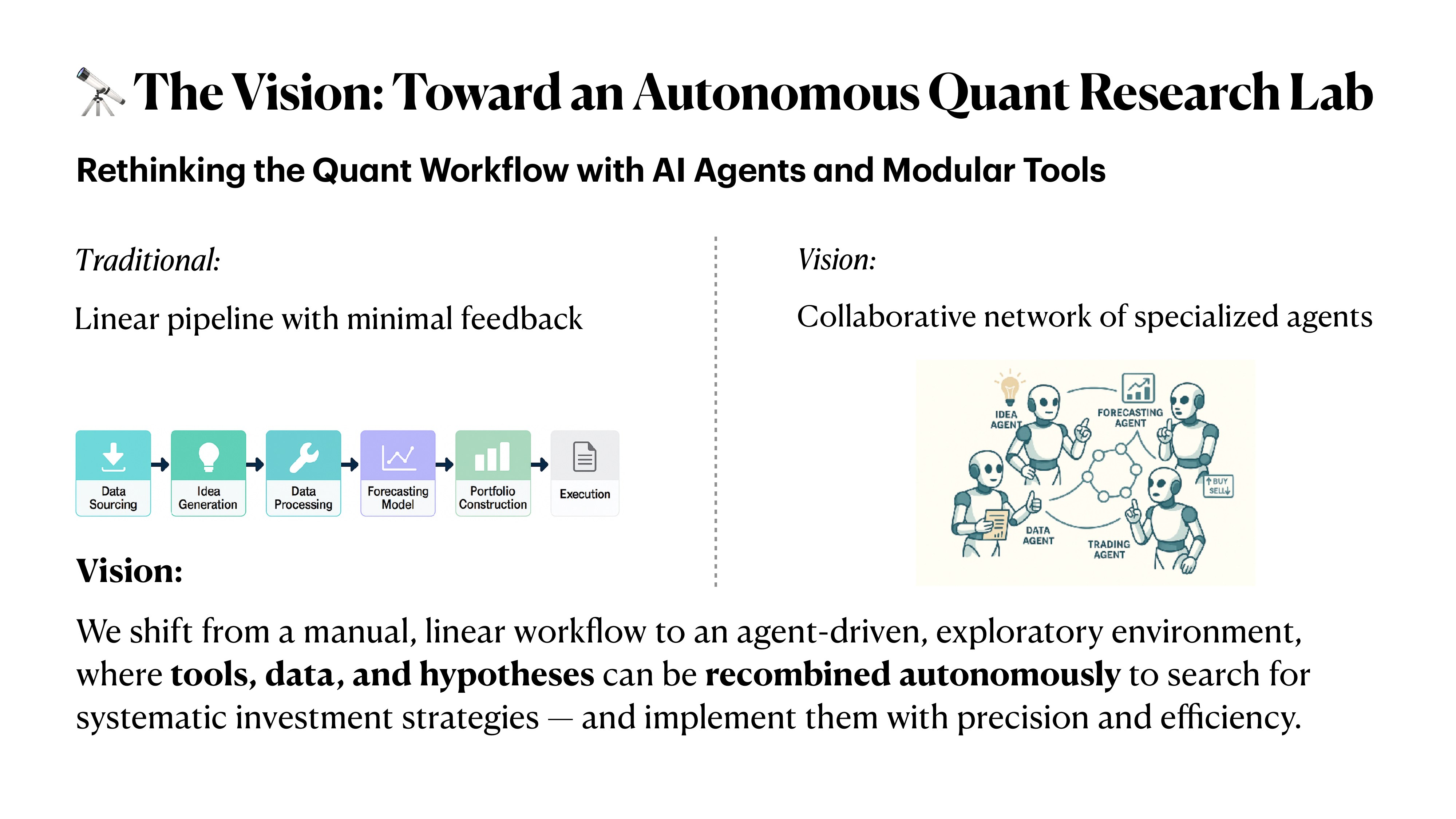
From my ICLR 2025 Expo presentation on AI agents and quantitative research.
The comparison is imperfect. Mathematics seeks durable and shareable truth. Investment research seeks useful knowledge in a competitive environment. A theorem does not become false when many people know it. An investment opportunity may disappear precisely because many people know it.
Still, both professions have historically depended on scarce human attention. A researcher could explore only a limited number of questions, read a limited amount of prior work and conduct a limited number of serious investigations. Artificial intelligence changes that constraint. It can increasingly participate in the complete arc of research: proposing directions, gathering evidence, testing alternatives, criticizing conclusions, documenting results and following up when reality disagrees.
What happens when research itself is no longer scarce?
An abundance of answers
The first consequence may be an extraordinary increase in the number of plausible answers. This should not be confused with an equivalent increase in knowledge.
When it is expensive to investigate an idea, the cost of the investigation acts as a crude filter. When thousands of investigations become cheap, that filter disappears. We gain the ability to examine far more possibilities, but we also create far more convincing mistakes, coincidences and explanations after the fact.
The bottleneck moves from producing results to deciding which results deserve attention and belief.
This resembles Tao’s discussion of mathematics, but with a crucial difference. Mathematics possesses the possibility of formal proof. Investment research has no final proof. A historical pattern can be genuine and still vanish. A sound idea can become crowded. An apparently robust result can depend on a world that no longer exists. Success changes the environment in which success was measured.
Quantitative research therefore remains permanently provisional. Its conclusions must live under continued observation rather than graduate into timeless facts.
Knowledge that loses value when shared
Mathematics has a strong public culture. Results are published, criticized, extended and placed into a common body of knowledge. Credit matters, but sharing usually increases the value of the field’s work.
Quantitative investing has almost the opposite incentive. Its most valuable knowledge is often kept private. Sharing an effective idea may reduce or destroy its value. Even within an organization, information is commonly divided according to role and need.
This difference may shape the institutional consequences of AI more than the technical capabilities do.
In mathematics, powerful research systems could support larger and more open collaborations. In investing, they may support smaller and more private ones. A few people, assisted by extensive machine intelligence, may be able to conduct the work that once required a much larger research organization.
The result could be a world of “small-team, big research”: compact groups operating private bodies of knowledge at a scale no individual could understand in full.
Will advantage concentrate?
There is a plausible future in which the number of people genuinely “in the know” shrinks. A small number of organizations may combine superior research systems, experience, data, capital and the feedback that comes from acting in markets. Each advantage reinforces the others. Better decisions produce better feedback; better feedback improves the system that makes the next decision.
This would not necessarily lead to a single dominant organization. Markets are too varied. Opportunities differ by scale, horizon, geography and temperament. Large pools of capital cannot pursue every small opportunity, and different participants will continue to see the world differently.
But the distribution of capability may become more unequal. The relevant divide may no longer be between firms that employ many researchers and firms that employ few. It may be between institutions that have built effective systems for accumulating and testing knowledge and those that still organize research as a collection of individual projects.
What becomes of the quant researcher?
It is easy to imagine the disappearance of the traditional role. Much of the work associated with quantitative research is procedural, even when it requires great technical skill. As machines become better at carrying out extended projects, fewer people may be needed to perform that work directly.
But this does not necessarily imply the disappearance of the researcher. It may imply a change in level.
The researcher of the future may spend less time producing each calculation and more time deciding what deserves to be calculated. Less time generating possible conclusions and more time examining the assumptions hidden beneath them. Less time moving one idea through a process and more time shaping the process through which many ideas compete.
The role begins to resemble that of an editor, architect and scientific director. Its central questions are qualitative even when the evidence is quantitative:
- Is this a meaningful question?
- What would change our mind?
- What has the system failed to notice?
- Is the apparent opportunity real, or only an artifact of our way of looking?
- Does the result remain valuable when it meets the world?
- When should we stop believing it?
Machines may become increasingly good at asking these questions too. But deciding which purposes an institution should serve, which risks it should accept and which consequences it is willing to own is not merely another research task.
Judgment or responsibility?
One possible future leaves humans with responsibility but little involvement. Machines make decisions; people provide signatures.
I do not think this is a stable or desirable division. Responsibility without understanding becomes ceremonial. A person cannot meaningfully accept responsibility for a system that no one is capable of questioning.
Human judgment remains valuable not because people will always calculate better, but because the world does not arrive as a fully specified problem. Objectives are incomplete. Values conflict. Evidence is ambiguous. Human judgment is often most valuable when it recognizes that a problem has been framed incorrectly, or that an important consideration is missing from the analysis.
Perhaps machines will eventually reproduce much of this judgment. Even then, an institution must decide what it means by success and who bears the cost of being wrong. The future human role may therefore be defined as much by accountable decision-making under uncertainty as by intellectual production.
The apprenticeship problem
There is another difficulty. Experts acquire judgment through work that later looks routine: making mistakes, investigating anomalies, discovering that elegant ideas fail, and living with consequences that cannot be seen in a textbook.
If machines take over the routine work, how will new researchers become capable of supervising them?
This problem is not unique to finance. Automation can remove drudgery, but drudgery sometimes contains the experiences from which intuition grows. Future research organizations may need to design apprenticeship deliberately rather than assume that expertise will emerge naturally from years of practice.
Learning may shift from doing every step personally to criticizing machine work, reconstructing failures, defending decisions and taking responsibility in stages. The ability to explain why a system is wrong may become more important than the ability to reproduce everything it can do.
A tentative conclusion
Quantitative research may be moving from a scarcity of experiments to an abundance of experiments. In that world, the scarce resources become good questions, trustworthy evidence, institutional memory, judgment and the capacity to act responsibly on uncertain knowledge.
The number of conventional quant researchers may fall. The amount of quantitative research may rise dramatically. Small groups may command capabilities that once belonged only to large organizations.
The profession is therefore unlikely to remain unchanged. But disappearance is not the only possibility. A role can lose most of its traditional tasks while retaining, or even increasing, its importance.
The future quant researcher may do less research in the old sense, while becoming more responsible for choosing what research is worth pursuing, deciding what evidence deserves confidence, and determining when a finding is robust enough to justify putting capital at risk.
A lot of discretion for systematic minds.
Further reading
- Terence Tao, “Mathematics in the age of AI”.
- Terence Tao, a living summary of his views on AI and mathematics.
- Tanya Klowden and Terence Tao, “Mathematical methods and human thought in the age of AI”.